The spaced repetition app that builds your reviews for you
Study a course in lezrn and every concept you learn gets its own review schedule, run by FSRS. No decks to make, no cards to keep up to date. Just a list of what's due each day.
7 days free · No card needed
What is spaced repetition?
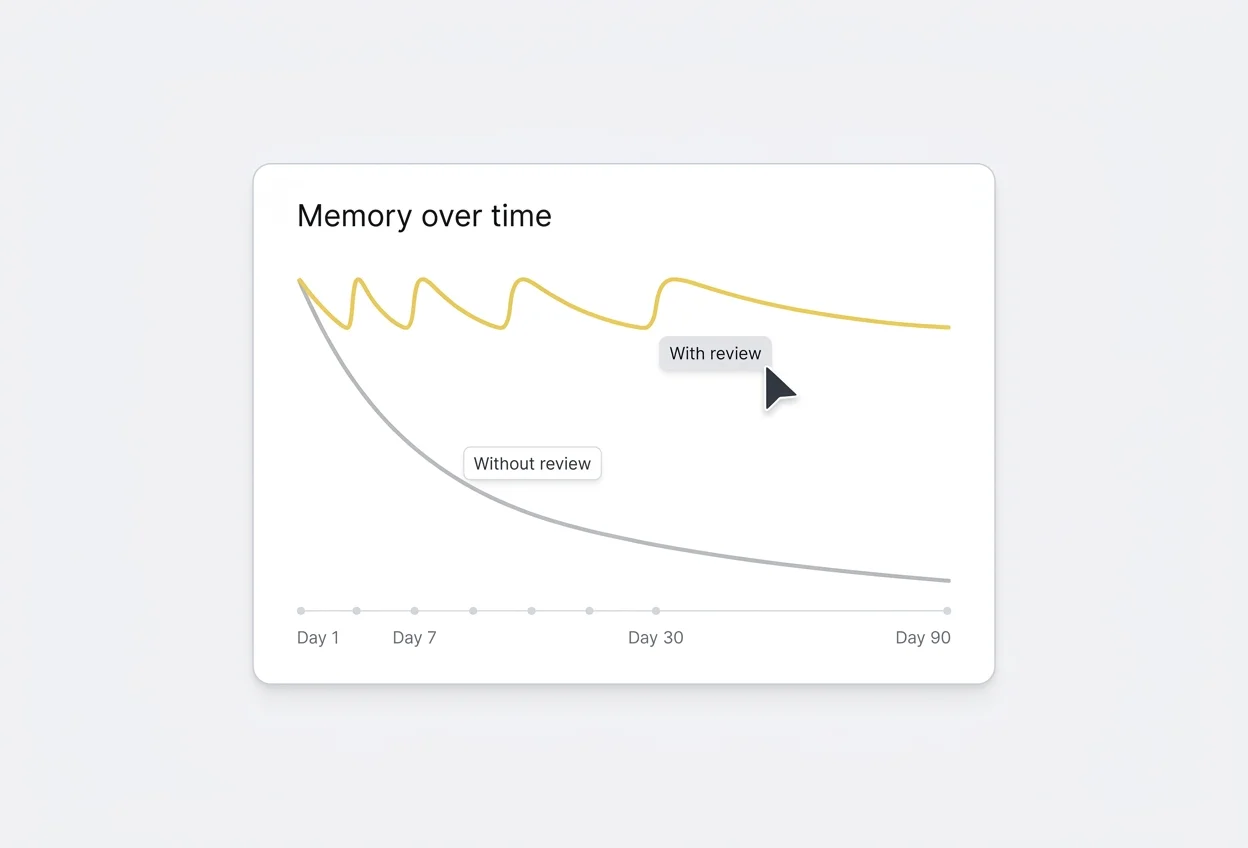
Spaced repetition means reviewing something right before you'd forget it, then waiting longer before the next review. Each time you pull a memory back up, it lasts longer, so the gaps keep growing: a day, then a few days, then weeks.
It's built on the forgetting curve, which Hermann Ebbinghaus mapped in the 1880s. Right after you learn something, you lose it fast. Every well-timed review flattens that drop.
The hard part is timing. Review too early and you waste time. Too late and you're relearning from scratch. That's the part software is good at, and the part lezrn does for you.
How lezrn schedules your reviews
Reviews are per concept, not per card, and they come from what you actually studied.
Study a lesson
Build a course from any topic, PDF or link, then work through the lessons. When you finish one, every concept it teaches joins your review schedule. There is no card-making step.
Get your first review
A new concept comes back about a day later. If the lesson only revisits something you met earlier, it waits about four days.
Recall, then check
Each review is one concept: its name on the front, the definition from your course on the back. Try to remember it, flip the card, then tap Forgot or Got it.
FSRS sets the next gap
FSRS tracks how hard each concept is for you and how stable your memory of it is. It books the next review for when you'd still have about a 90% chance of remembering. Get it right and the gap grows. Forget it and it comes back within a few days, often the next day.
What the gaps look like
For a concept you keep getting right, on time, the reviews land roughly here:
- 1st review1 day after the lesson
- 2nd review4 days later
- 3rd reviewAbout 2 weeks later
- 4th reviewAbout 7 weeks later
Gaps top out at a year. Once a concept's next gap reaches three weeks, lezrn counts it as mastered. Blurting and Feynman practice inside lessons also grade how well you recalled each concept, and those grades move the same schedule.
Your plan for today
The Review page shows what's due now, your next lesson, this week, and a day-by-day count of what's coming up. Nothing due? Practice ahead pulls in the next few concepts early.
Missed a few days?
Missed reviews stay due, and today's plan notes how many days you missed. When you catch up, FSRS uses the real time since your last review, so the schedule adjusts instead of starting over.
Spaced repetition vs cramming
Cramming
- One long session the night before.
- Feels productive, because everything is fresh.
- Fades fast, so you relearn it all for the final.
Spaced repetition
- Short sessions spread over days and weeks.
- Feels harder, because you have to dig for the answer.
- That digging is what makes it last.
Cramming isn't useless. It can get you through tomorrow morning. But if the material comes back on a final, in the next course or at work, spacing wins. The best plan is both: short spaced reviews all term, then one last pass before the exam.
lezrn vs a flashcard deck app
Deck-based apps like Anki are popular for a reason: you control every card. lezrn takes the other route. Here's the honest difference.
| Topic | A deck app | lezrn |
|---|---|---|
| Where reviews come from | A deck appCards you write or import | lezrnThe concepts in lessons you finish |
| Setup | A deck appMake decks, pick settings | lezrnNone. Finish a lesson and it's scheduled |
| One review is | A deck appWhatever you put on the card | lezrnOne concept and its definition from your course |
| Scheduler control | A deck appUsually lots of settings to tune | lezrnFSRS with fixed settings and a 90% target |
| The material itself | A deck appYou learn it somewhere else first | lezrnLessons, quizzes and practice sit next to the reviews |
Pick a deck app if you want to hand-craft every card, like vocab with audio or a deck someone shared with your class. Pick lezrn if you're learning a subject and don't want the card-making job on top of it. Want cards from your own notes right now? The AI flashcard maker and PDF to flashcards are free, no account needed.
Frequently asked questions
What is a spaced repetition app?
An app that decides when you should review each thing you're learning, so every review lands right before you'd forget it. Most of them make you build the flashcards yourself. lezrn builds the review items from the courses you study.
Is there a spaced repetition app without flashcards?
Close to it. In lezrn you don't have to make or edit any cards. Reviews still look like a card, with a concept on the front and its definition on the back, but they come from your lessons automatically. Blurting and Feynman practice inside lessons also update the same schedule.
What is FSRS?
FSRS stands for Free Spaced Repetition Scheduler. It's an open-source algorithm that tracks three things for each memory: difficulty, stability (how long it lasts) and retrievability (the chance you'd recall it right now). lezrn runs FSRS-4.5 with its default weights and books each review for when that chance drops to about 90%.
What happens if I miss a day?
Nothing breaks. Reviews you missed stay due and show up in today's list, with a note saying how many days you missed. They aren't quietly moved to later days. When you do review them, FSRS uses the real time that passed, so remembering something after a long gap pushes the next review further out.
How long does a daily review take?
It depends on how much you're studying. The Review page estimates about 20 seconds per concept, so 15 concepts is around five minutes. Reviewing doesn't use credits.
Is lezrn free?
Every account starts with a 7 day free trial, no card needed, and spaced review is included. After that it is a paid plan. The free AI tools, like the AI flashcard maker, work without an account, 3 generations a day.
Free tools that pair with it
Learn it once, then keep it
Type a topic or drop in a PDF. Your first lesson is usually ready in about a minute, and the reviews schedule themselves.
Start free7 days free · No card needed